Contents How do keyword match types work?
The right keywords are the key to a successful Google Ads search campaign. Google gives us 3 different match types. Each has advantages and disadvantages.
Quick answer: Match types still matter in 2026, but the strategic balance has shifted decisively towards Broad Match + Smart Bidding. With AI Max being auto-rolled out from September 2026, match types lose weight as a targeting mechanism and gain weight as a signal for Google’s AI.
If you don’t have an account yet, start with the Google Ads account setup first and come back here afterwards.
How do keyword match types work?
When you add keywords in Google Ads, there are 3 options:
- Broad Match
- Phrase Match
- Exact Match
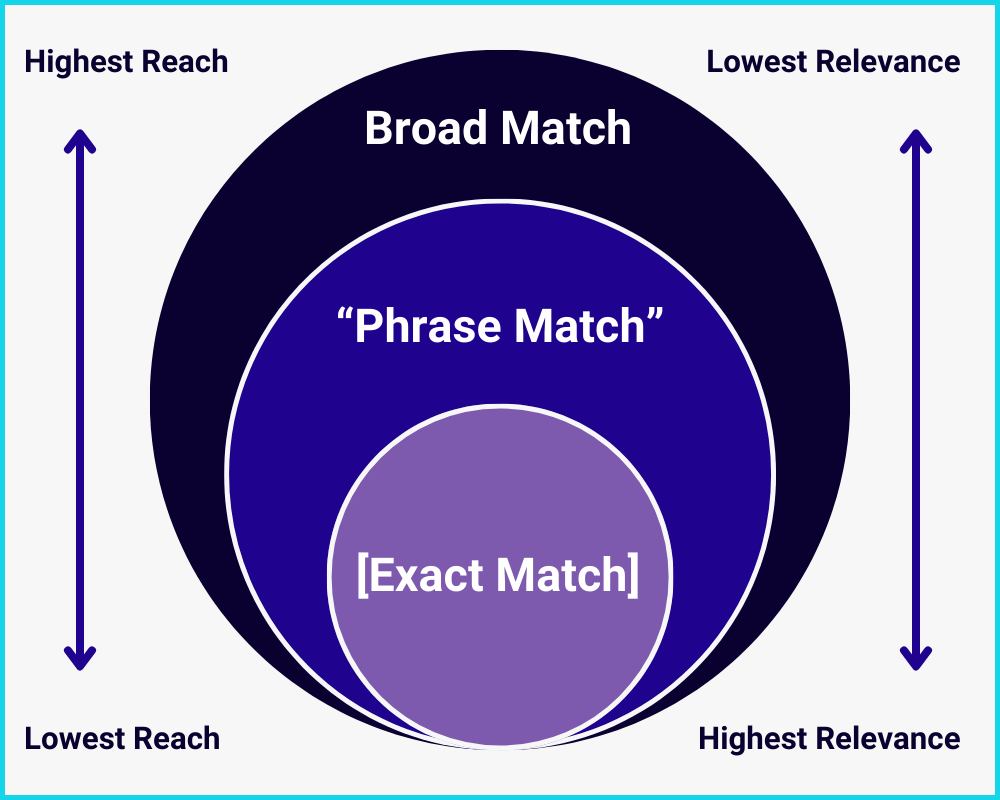
Match types give you control over how relevant a search query must be to your specified keyword in order to trigger an ad. Rule of thumb:
From broad match to exact match, the relevance increases and possible reach decreases.
Search Term vs. Keyword: What’s the difference?
In Google Ads, there are search terms and keywords. Even though these terms sound like synonyms, they are two different concepts.
Keywords are words or groups of words that you add to Google Ads at the ad group level. They determine for which searches your ads will be triggered.
Search terms are the actual literal search queries that triggered your ads. They tell you about the real searches of your users.
How does the mechanism work? For each search query, Google checks whether the search term has the same or a similar meaning as one of your keywords. If the meaning is similar but not exactly the same, the match type of the respective keyword determines whether an ad is triggered.
Which 3 match types are there?
In Google Ads there is broad match, phrase match and exact match. The match type determines how much reach a keyword can achieve and how relevant the individual search queries have to be.
How does Broad Match work in 2026?
Broad match is the broadest keyword match type in Google Ads. It is also Google’s default option and the centerpiece of Google’s AI-driven campaign strategy in 2026.
For an ad to be triggered, broad match only requires that a search query has a meaning related to the keyword. Spelling and exact words don’t matter as long as there is a thematic match.
Broad Match takes more than the keyword into account
According to Google’s own statements, broad match keywords also use signals beyond the search query:
- The past search activity of the user
- The content of the landing page
- The importance of other keywords in the same ad group
- The active bid strategy
This is no longer purely lexical matching, it’s intent matching.
Best Practice 2026: Broad Match + Smart Bidding
Broad match keywords work best when paired with Smart Bidding (Maximize Conversions, Maximize Conversion Value, Target CPA, Target ROAS). 62 percent of advertisers using Smart Bidding now use Broad Match as their primary match type. The auction-time bidding mechanism compensates for the breadth with selection precision in every single auction.
Without Smart Bidding, broad match remains risky.
How does Phrase Match work in 2026?
For a phrase-match keyword, an ad is only triggered if the search term has a similar meaning or intention. Phrase match sits between broad and exact match.
To select this option, enter your keyword in quotation marks ("keyword").
After the 2021 update, the exact word order is no longer strictly enforced and phrase match also covers meaning variations. In practice, phrase match has moved significantly closer to broad match.
How does Exact Match work in 2026?
For an exact-match keyword, an ad is only triggered if the search term has the same meaning or intent. Exact match gives you the most control.
To select this option, enter your keyword in square brackets ([keyword]).
Despite the name, exact match in 2026 is no longer purely literal. It covers:
- Different word order (
[running shoes women]also matches “women’s running shoes”) - Singular/plural variations
- Same meaning with different words
- Plurals and stop words
It’s still the tightest match type, but less rigid than the name suggests.
Match type comparison: pros and cons
| Feature | Broad Match | Phrase Match | Exact Match |
|---|---|---|---|
| Reach | High | Medium | Low |
| Control | Low | Medium | High |
| CTR | Low | Medium | High |
| Ad relevance | Variable | Medium | High |
| Negative-keyword management effort | High | Medium | Low |
| Discover new keywords | Good | Good | None |
| Best use for | Smart Bidding + scale | Balanced control and reach | Brand protection, top performers |
What AI Max means for match types
AI Max is Google’s AI extension layer for search campaigns. It uses Broad Match + Keywordless Technology to find relevant search queries based on keywords, landing pages, assets, and URLs.
What that means for you: Match types lose weight as a targeting mechanism but gain weight as a signal for the AI. Broad Match + Smart Bidding becomes the default combo.
You want more results with Google Ads?
Get a free Google Ads Reality Check: a compact video (about 10 minutes) showing where budget is slipping away in your account and what to change.
Get your Google Ads Reality Check →
When to use which match type? 3 strategies for 2026
There’s no single recipe that works for every campaign. The right match type depends on campaign duration, budget, and search volume. You can also combine match types.
1. Broad Match + Smart Bidding (Default 2026)
Google’s preferred strategy and the most-used setup in advanced accounts. Include 1-3 broad-match keywords per ad group that describe your offer. Combined with Smart Bidding (Maximize Conversions, Maximize Conversion Value) and clean conversion tracking, you tap into Google’s AI power.
2. Exact Match for Brand and Top Performers
Use exact match in separate campaigns for:
- Brand protection: Your own brand terms as exact match in a dedicated search campaign.
- Top-performer keywords: Keywords with consistently strong conversion rate, isolated into a best-performer campaign.
- Priority over PMax: For identical search queries, an exact-match keyword in a search campaign generally takes priority over PMax. This is your brand-protection lever against PMax cannibalization. See PMax vs. Search.
3. Broad Match + Exact Match in one ad group
Combine broad match (for discovery) and exact match (for control and CTR) in one thematically grouped ad group.
Broad match finds new converting search queries that you can then promote into exact match. This is the classic “test-and-promote” loop and works well early in a campaign.
How do match types work for negative keywords?
The match types for negative keywords work differently than for normal keywords. Here, spelling is still crucial.
- Broad Match: Blocks all search queries that contain the same words in any order.
- Phrase Match: Blocks only search queries that contain the same words in the same order.
- Exact Match: Blocks only search queries that match the keyword exactly. No additional words allowed.
For a deeper dive, see Remove redundant keywords and the post on keyword grouping.
Conclusion: match types in 2026
Understanding match types remains extremely important. But the strategic center of gravity has shifted: Broad Match + Smart Bidding is the new default, exact match keeps its role for brand protection and top performers, and AI Max from September 2026 will further reduce the weight of granular keyword control.
Good luck with your campaigns.
Work smart with Clicks in Mind
You might also like
 Search
 How many Ad Groups per Google Ads Campaign in 2026?
Ideal ad-group count per Search campaign in 2026: 3-10 thematic clusters. AI Max context + structuring guide.
Read more → Search
 How many Google Ads per Ad Group in 2026?
How many RSAs per ad group in 2026? 1-2 are enough, large ad groups can use up to 3. AI Max context + A/B test setup step by step.
Read more → Search
 What are Broad Match Keywords in Google Ads? (2026 Guide)
Broad Match in 2026: bridge to AI Max from September 2026 + default combo with Smart Bidding. Mechanics, use cases, and risks explained.
Read more →You want more results with Google Ads?
Get a free Google Ads Reality Check: a compact video (about 10 minutes) showing where budget is slipping away in your account and what to change.
Get your Google Ads Reality Check