Contents Why does a good campaign structure matter?
The right structure is the key to Google Ads success. That applies to both the whole account and individual campaigns. The challenge: the Google Ads landscape changes fast.
In this post, I’ll explain how to structure your campaigns in 2026 and how many ad groups you should use.
Quick answer: The ideal number of ad groups per campaign in most cases is between 3 and 10. It depends on how many thematically appropriate groups the campaign can be subdivided into. AI Max doesn’t change that: thematic separation remains important, even though AI Max softens the matching logic internally from September 2026 onwards.
Why does a good campaign structure matter?
There are two important reasons to think about the right campaign structure:
-
Simpler campaign optimization: Launching a campaign is easy. The real challenge is optimizing performance. Google Ads gives you a lot of data. A good campaign structure makes it easy to spot improvement opportunities and pause underperforming ad groups or keywords.
-
Cheaper clicks through higher ad relevance: Google cares deeply that ads shown to users are actually relevant. That’s the whole business. If your ad and landing page match the query, your Ad Rank increases. Google then prefers your ad and shows it for a lower CPC.
A good campaign structure not only makes your life easier but also lowers your cost per click and ultimately cost per conversion.
What is a campaign?
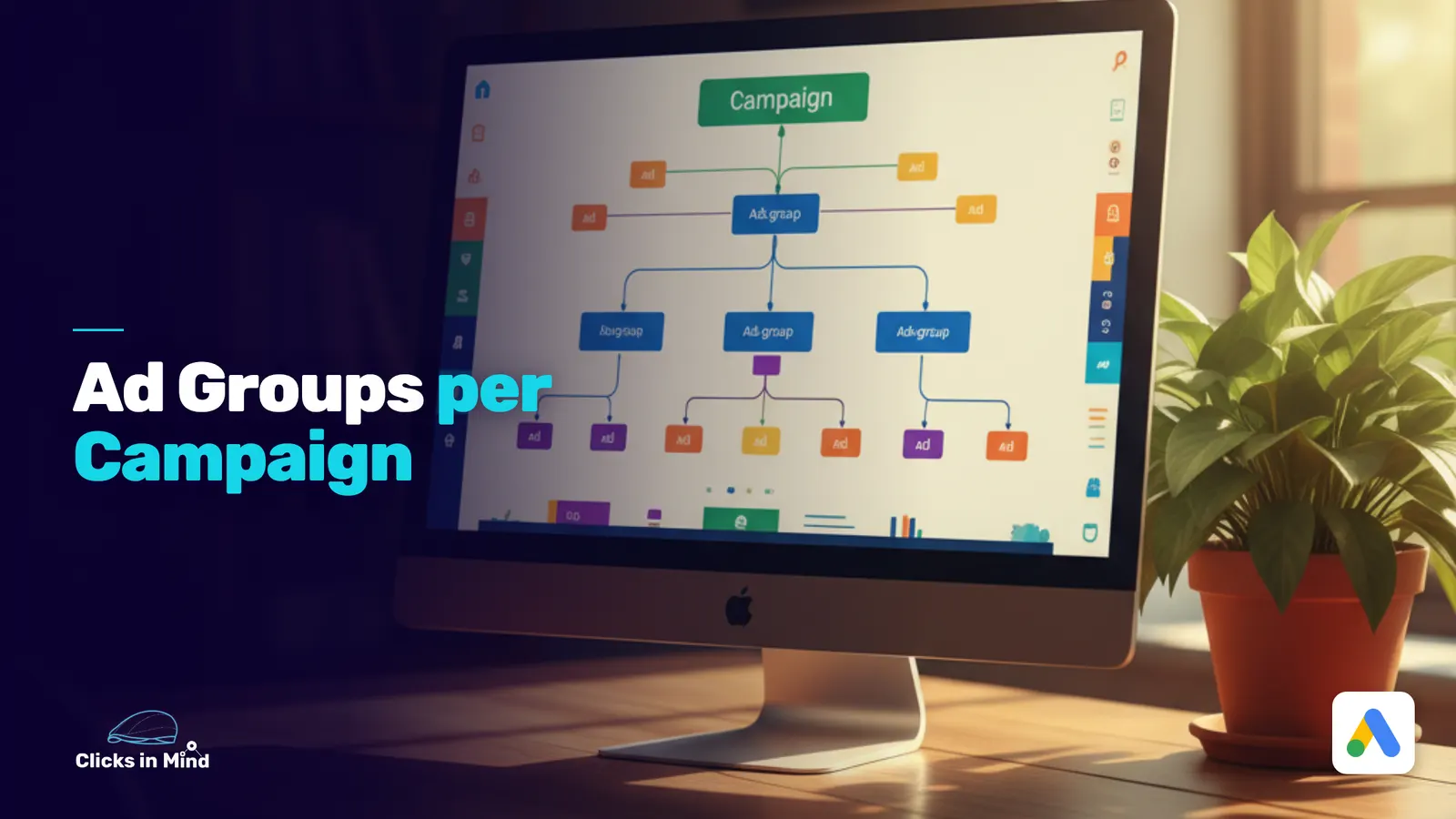
A Google Ads campaign consists of one or more ad groups. At the campaign level, you control the most important settings:
- Budget
- Geographic targeting
- Campaign type (Search, Display, Shopping, PMax)
- Bidding strategy
In the Google Ads structure, the campaign is the parent category, subdivided through ad groups.
Campaign example
For Fashion 123, an online clothing store, it makes sense to create a campaign for every top-level category: Shoes, Pants, Shirts, etc.
What is an ad group?
Ad groups further subdivide a campaign. They contain keywords, ads, and other targeting options. An ad group consists of defined keywords and up to 3 active Responsive Search Ads.
They don’t always need to be 3. More in How many ads per ad group.
Ad group example
To subdivide the Shoes campaign, Fashion 123 uses ad groups categorizing the shoes sold. So there’s one ad group each for Running Shoes, Sneakers, High Heels, etc.
How to structure a campaign
The goal is to subdivide the advertised product group or service into meaningful clusters. This way you can ensure you always show highly relevant ads to your target group, increasing the chance of clicks and conversions.
A cluster doesn’t always have to be a product or service sub-group. It often makes sense to create different ad groups by user intent, seasonal events, or promotions.
How to approach it
Since it’s about creating a matching ad for every relevant query, the ad group subdivision is based on grouping possible queries.
- Make a list of all relevant queries for your campaign theme. A very helpful tool: the Google Keyword Planner.
- Organize the queries into thematically matching clusters, e.g. “Shoes Online Store”, “Buy Shoes”, “Running Shoes”.
- Create one ad group per cluster with matching ads that address the specific theme in their texts.
Keywords are interpreted more broadly
Google’s algorithms are extremely good at understanding the semantic meaning of a search query. There’s no need to add multiple keyword variations to your ad groups.
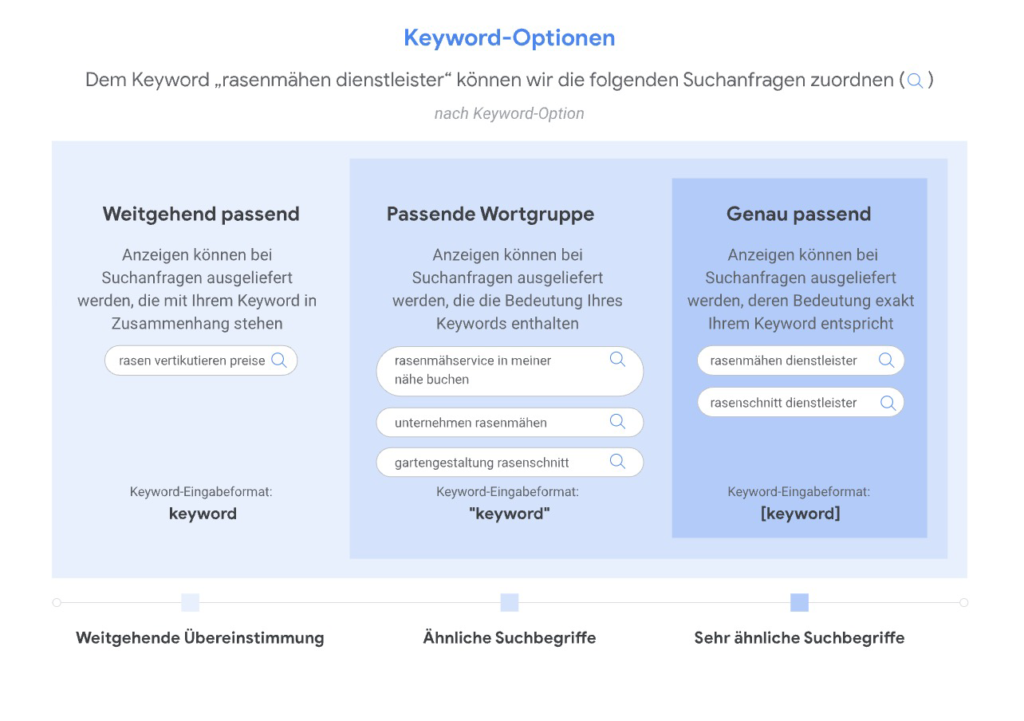
Even Exact Match keywords now trigger ads for semantically relevant queries without containing the same word. Phrase Match and Broad Match are even broader. More in Keyword Match Types in Google Ads.
That means you no longer need to cluster ad groups as granularly. As long as different queries share the same intent, they’re treated the same. For grouping mechanics, see How to Group Keywords.
How many ad groups per campaign are optimal?
The number of ad groups equals the number of distinct keyword clusters that arise from your campaign theme. Depending on theme size, the optimal number varies.
Since Google often interprets queries broadly, 3 to a maximum of 10 ad groups are usually enough.
With more ad groups, themes tend to overlap and you can reduce. A look into the search terms report helps.
AI Max from September 2026: does anything change?
From September 2026, Search campaigns with campaign-level Broad Match get auto-upgraded to AI Max. AI Max uses Broad Match + Keywordless Technology to find queries via keywords, landing pages, assets, and URLs.
For the “how many ad groups?” question, this changes little. The thematic separation is the signal you give the algorithm. What does change: you no longer need to worry as much about keyword granularity per ad group. The 3-10 ad group rule of thumb remains the clean default.
You want more results with Google Ads?
Get a free Google Ads Reality Check: a compact video (about 10 minutes) showing where budget is slipping away in your account and what to change.
Get your Google Ads Reality Check →
Google gets smarter, campaigns get leaner
Through better understanding of search intent and more automation, Google takes a lot of work off your plate. You don’t have to worry about spellings and synonyms. Google handles that.
The right structure remains the key to success. In most cases, the ideal number of ad groups is between 3 and 10, with clean thematic separation and no overlaps.
I hope this post was helpful. Good luck structuring your campaigns.
Work smart with Clicks in Mind
You might also like
 Search
 How many Google Ads per Ad Group in 2026?
How many RSAs per ad group in 2026? 1-2 are enough, large ad groups can use up to 3. AI Max context + A/B test setup step by step.
Read more → Search
 What are Broad Match Keywords in Google Ads? (2026 Guide)
Broad Match in 2026: bridge to AI Max from September 2026 + default combo with Smart Bidding. Mechanics, use cases, and risks explained.
Read more → Search
 What are Exact Match Keywords in Google Ads? (2026 Guide)
Exact Match in 2026: no longer purely literal. Use it for brand protection, top performers, and PMax priority. Mechanics + use cases.
Read more →You want more results with Google Ads?
Get a free Google Ads Reality Check: a compact video (about 10 minutes) showing where budget is slipping away in your account and what to change.
Get your Google Ads Reality Check