Contents Why does the ad count matter?
Google Ads is a system that keeps changing. Best practices from yesterday are often outdated today. The same goes for ad group structure. Wondering how many ads you need per ad group? This post answers it.
Quick answer: For a successful search campaign, one Responsive Search Ad (RSA) per ad group is enough. To generate additional insights, however, it’s recommended to run 2 ads that test a specific aspect. In large, well-funded ad groups you can use the maximum of 3 RSAs.
Why does the ad count matter?
Right ad design and structure are crucial for successful Google Ads campaigns. That includes the number of different ads per ad group.
The ad signals to users that your offering is what they’re looking for. That doesn’t always work right away. One indicator is a low CTR below 3%.
The idea of multiple ads in one ad group is to test different ad copy. That way you find out which communication style performs best.
Outdated: the old ad structure
Until recently, the rule of thumb was:
For a successful ad group, you need 3-5 ads per ad group.
There was also the strategy of placing only one keyword per ad group, so ads were maximally relevant to the search query. These are called Single Keyword Ad Groups, or SKAGs.
More in Keywords per Ad Group.
What has changed?
New ad type
The old rule of 3-5 ads per ad group was based on the Expanded Text Ad. Since June 30, 2022, you can no longer create or edit these.
The ad type has been replaced by the Responsive Search Ad (RSA). For new ads, only this type is available. That brings benefits and changes.
RSA vs. Expanded Text Ad
The idea behind Responsive Search Ads is automated ad testing. While the old version had fixed slots (3 headlines and 2 descriptions), an RSA lets you provide up to 15 different headlines and 4 different descriptions.
Google then automatically tests text combinations and optimizes performance. At least in theory. In practice, it doesn’t always work.
Keywords are interpreted more broadly
Google’s algorithms are extremely good at understanding the semantic meaning of a search query. There’s no longer a need to add multiple keyword variations to your ad groups.
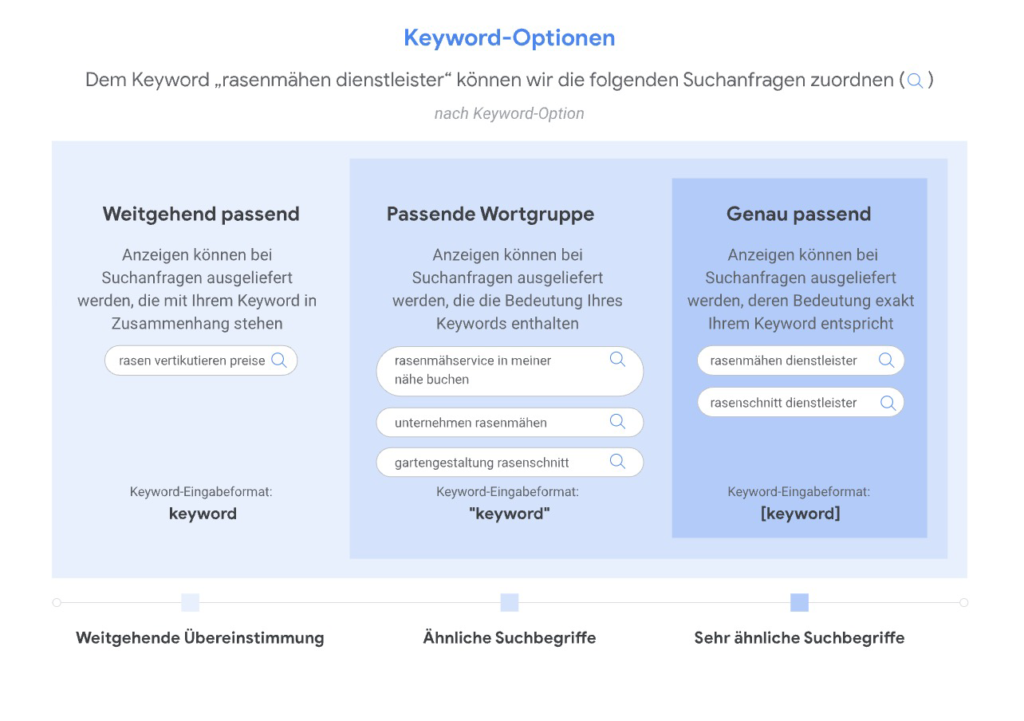
Even Exact Match keywords now trigger ads for semantically relevant queries without containing the same word. Phrase Match and Broad Match are even broader. More in Match Types in Google Ads.
SKAGs containing only one keyword that ads are optimized to no longer work the way they used to. That affects the optimal number of ads per ad group too, because you can’t focus your texts on one specific spelling of your focus keyword anymore.
Optimal number of ads per ad group in 2026
How does it look after all these changes? How many ads should you use?
For a successful search campaign, you don’t need more than 1 ad per ad group.
Google itself needs about 2000-3000 impressions per month per ad to optimize. With enough budget, 1 ad per ad group works without issues.
Optimizing the ad
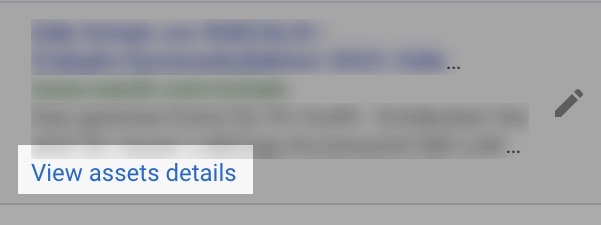
With Responsive Search Ads, optimization works differently than with Expanded Text Ads. Once Google has collected enough data (2000-3000 top impressions), you’ll find valuable insights in the ad report under “View asset details”:
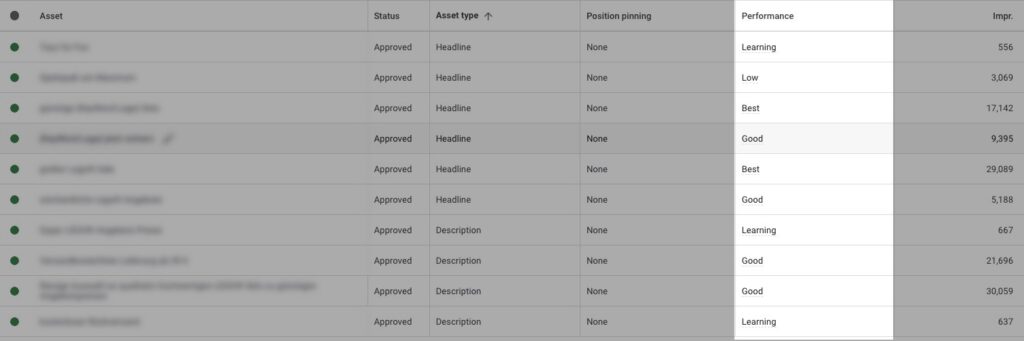
You’ll see an overview of the texts used and their performance. Google categorizes:
- Learning: Google doesn’t have enough data yet
- Low: The text underperforms. Replace it.
- Good: The text performs well, but there’s room
- Best: The text drives best performance
My 2026 recommendation
If you have enough budget for your campaigns, Google can collect and optimize data even with one ad.
BUT: In my experience, it often takes a long time until Google has collected enough data and shows you the valuable insights.
That’s why I recommend running 2 ads in parallel.
This way you test different aspects of your ads independently and learn faster what works. In very large ad groups with high volume, you can use all 3 RSA slots, but then deliberately with 3 distinct hooks or angles.
A note on AI Max campaigns from September 2026: If Google has upgraded your campaign-level broad match search campaign to AI Max, AI Max additionally pulls in landing page content and account assets as signals. Asset quality in RSAs becomes even more important, because AI Max relies more heavily on your asset library.
You want more results with Google Ads?
Get a free Google Ads Reality Check: a compact video (about 10 minutes) showing where budget is slipping away in your account and what to change.
Get your Google Ads Reality Check →
A/B testing in Google Search Ads
Two aspects matter for a meaningful test:
- The test setup: what is being tested?
- The decision criterion: how and when do you decide?
Test setup
Most important: only test one aspect at a time. Copy the existing ad, change one thing, and run both variants in parallel.
You can test, for example:
- Pinning a single headline or description
- Swapping a headline or description
- Different landing pages
Decision criterion
After the test has run for a while, decide which variant is the winner. Let the test run for at least 30 days. Ideal: both variants have collected at least 1000 impressions.
If so, decide based on two metrics: CTR and Conversion Rate.
If one ad has a significantly higher Conversion Rate (with significant impressions), that’s the winner.
If Conversion Rate is roughly equal, look at CTR. A higher CTR signals better ad relevance and leads to lower CPC over time. In that case, the higher-CTR variant wins.
Optimal number of ads in other campaign types
So far this post covered search campaigns. Other campaign types are interesting too.
How many Display Ads per ad group?
In Display, besides text, the image plays a central role. Google itself recommends 3-4 different ads per ad group.
This way Google’s algorithm finds the best-performing image. Works for both manual and Responsive Display Ads. Important: only change the image, keep the text constant.
Remember: Always test one aspect at a time.
How many Asset Groups in a Performance Max campaign?
In Performance Max, things work differently. There are no ads and ad groups, both are mapped via Asset Groups.
Generally, use Asset Groups to subdivide your campaign. For every sub-category, create at least one Asset Group. More on 2026 minimums in PMax Asset Group Structure.
There’s no “best number” here, it depends on the rest of your campaign setup. The cap is 25 Asset Groups per campaign.
More on search campaign structure in Ad Groups per Campaign.
Work smart with Clicks in Mind
You might also like
 Search
 How many Ad Groups per Google Ads Campaign in 2026?
Ideal ad-group count per Search campaign in 2026: 3-10 thematic clusters. AI Max context + structuring guide.
Read more → Search
 What are Broad Match Keywords in Google Ads? (2026 Guide)
Broad Match in 2026: bridge to AI Max from September 2026 + default combo with Smart Bidding. Mechanics, use cases, and risks explained.
Read more → Search
 What are Exact Match Keywords in Google Ads? (2026 Guide)
Exact Match in 2026: no longer purely literal. Use it for brand protection, top performers, and PMax priority. Mechanics + use cases.
Read more →You want more results with Google Ads?
Get a free Google Ads Reality Check: a compact video (about 10 minutes) showing where budget is slipping away in your account and what to change.
Get your Google Ads Reality Check