Contents Why does the keyword count per ad group matter?
The right structure is the key to Google Ads success. That applies to both the whole account and individual ad groups. The challenge: the Google Ads landscape changes fast.
In this post, I’ll explain how many keywords you should put in an ad group.
Quick answer: The 2026 recommendation is 3-10 thematically tight keywords per ad group. Rather create more ad groups for theme variations than overload one ad group with 20+ keywords. SKAGs (Single Keyword Ad Groups) make little sense in 2026, because match types have become too fuzzy.
Why does the keyword count per ad group matter?
Ad groups are how you segment your campaigns. The benefit: you can show users the most relevant ads possible. These ads should be highly relevant to the search query.
Google rewards high ad relevance. When your ad and landing page match the search query, your Ad Rank increases. Your CPC decreases over time.
What role does the keyword count play?
The keyword count matters for ad relevance. Can the ads in one ad group really be relevant for 100+ different keywords? Clear answer: no.
For this reason, you should avoid putting too many keywords into one ad group. It’s better to split them across multiple ad groups.
As often: quality over quantity.
What are the downsides of “too many” keywords?
- Budget constraints: The budget is limited. Many keywords get no clicks or impressions.
- Poor overview: Budget is split across too many keywords, and you can’t tell which ones work.
- High management overhead: Gathering, entering, evaluating.
How keywords work in 2026
Google’s algorithms are extremely good at understanding the semantic meaning of a search query. It’s no longer necessary to add multiple keyword variations to your ad groups.
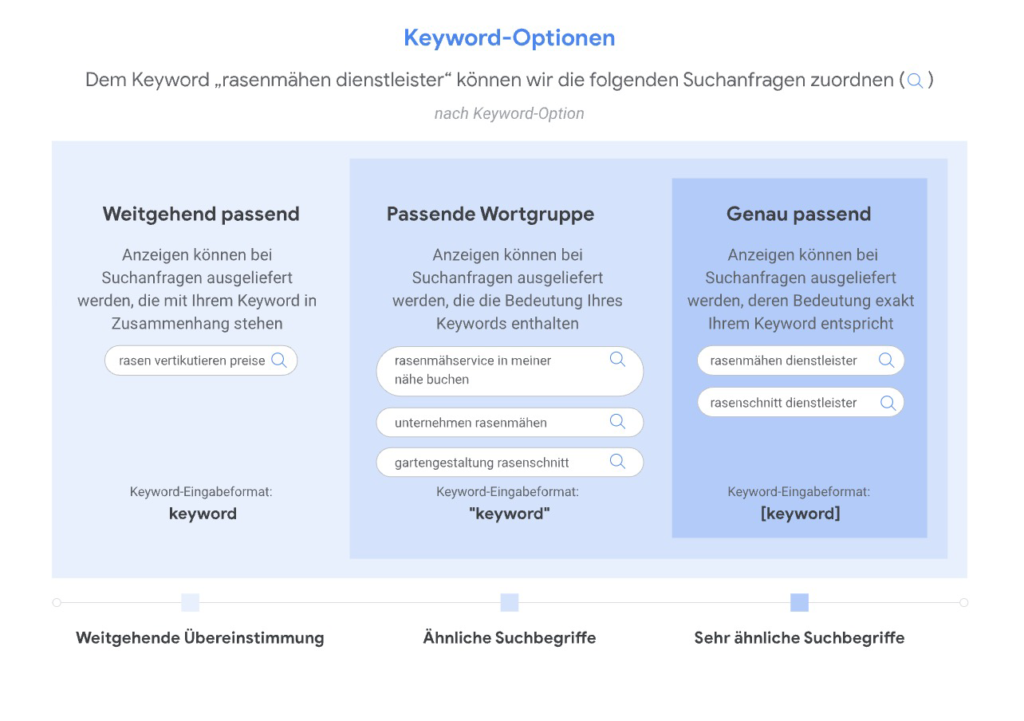
Even exact-match keywords now trigger ads for semantically relevant queries that don’t contain the same word. Phrase Match and Broad Match are even broader. For successful campaigns, understanding match types is essential: Match Types in Google Ads.
Implications
Since Google understands user intent, spelling no longer matters. What matters is the meaning behind it. You no longer have to worry about synonyms, singular/plural, or typos.
This alone is a reason to reduce the number of keywords.
The 2026 recommendation
The trend in advanced Google Ads accounts in 2025/2026 is clear: smaller keyword lists, more Broad Match, stronger reliance on Smart Bidding.
Concrete rule of thumb: 3-10 thematically tight keywords per ad group, then create more ad groups for theme variations rather than stuffing one ad group with 20+ keywords.
Background: Match types in 2026 are significantly fuzzier than 5 years ago. Google’s AI uses account context and landing page content to match queries. So there’s less value in “covering as many keyword variations as possible” and more value in “clean thematic ad group structure that Google reads as a signal”.
How to structure ad groups
For every distinct user intent, you should create an ad group. This is often called Keyword Themes.
What is a Keyword Theme?
A Keyword Theme is a group of related search queries with a shared search intent.
- Lawn Mowing Service: Generic keywords. Example: “lawn mowing service”, “lawn mowing provider”.
- Lawn Mowing Service Cost: Financial queries. Example: “lawn mowing service cost”, “how much does lawn mowing cost?”.
- Lawn Mowing Service Location: Local queries. Example: “lawn mowing service near me”, “lawn mowing service NYC”.
Important: In each ad group, address the respective theme in the headlines. In the “Lawn Mowing Service Cost” ad group, for example, price should be a topic in the ads.
For more on grouping your keywords, see Keyword Grouping.
You want more results with Google Ads?
Get a free Google Ads Reality Check: a compact video (about 10 minutes) showing where budget is slipping away in your account and what to change.
Get your Google Ads Reality Check →
Single Keyword Ad Groups (SKAGs) are over in 2026
The once-popular SKAG model (one ad group per keyword) made sense when Exact Match was literal. Today, Exact Match also matches synonyms and variations, and Broad Match has become the default. SKAGs lose their technical purpose.
If you’re still running SKAGs, you’re building massive complexity for no clear benefit. Consolidating into thematic ad groups is the clean migration.
Why I still use more than one keyword
I’ve explained that Google is getting smarter and understands the intent behind a keyword. Why do I still add multiple variations to my ad groups?
The reason: dynamic keyword insertion in my ads.
If you’re not familiar:
“With keyword insertion, your ads automatically update with the keywords in your ad group that triggered them.”
If you’ve only added one keyword, only that one keyword gets inserted into the ad. In many cases, it’s worth covering a few variations so you better match the language of your prospects.
In solar, there are two terms: “solar panel” and “PV system”. To Google, these are the same. But a user probably wants a result that uses the same word they used.
If they searched for “PV system”, your ad should show a headline like “High-Quality PV Systems”, not “Solar Panels”.
Google gets smarter, campaigns get leaner
By better understanding search intent, Google takes a lot of work off your plate. You don’t have to worry about different spellings and synonyms. Google handles that.
If you use dynamic keyword insertion, it’s still worth adding a few different spellings.
The trend is clearly towards leaner Google Ads campaigns. With AI Max from September 2026, this trend will accelerate.
I hope this post was helpful. Good luck.
Work smart with Clicks in Mind
You might also like
 Search
 How many Ad Groups per Google Ads Campaign in 2026?
Ideal ad-group count per Search campaign in 2026: 3-10 thematic clusters. AI Max context + structuring guide.
Read more → Search
 How many Google Ads per Ad Group in 2026?
How many RSAs per ad group in 2026? 1-2 are enough, large ad groups can use up to 3. AI Max context + A/B test setup step by step.
Read more → Search
 What are Broad Match Keywords in Google Ads? (2026 Guide)
Broad Match in 2026: bridge to AI Max from September 2026 + default combo with Smart Bidding. Mechanics, use cases, and risks explained.
Read more →You want more results with Google Ads?
Get a free Google Ads Reality Check: a compact video (about 10 minutes) showing where budget is slipping away in your account and what to change.
Get your Google Ads Reality Check