
Contents Your key takeaways
Performance Max (PMax) campaigns are both a blessing and a curse. You give up a lot of control and hope that Google’s AI achieves your campaign goals more efficiently in return: more sales, lower lead prices, or more store visits.
To achieve that, Google draws on a variety of different signals. Some you define yourself when creating the campaign. The rest the AI learns over time. We call this period the learning phase. After all, it’s called Machine Learning for a reason.
To achieve your goals with PMax campaigns, it’s important to understand the learning phase. This helps you draw the right conclusions and deploy your budget optimally.
Your key takeaways
- Duration: Typically 2 to 4 weeks, can range from 1-2 weeks (high budget, 300+ USD/day) to 5-6 weeks (small budget under 50 USD/day).
- Conversion thresholds: At least 30-50 conversions per 30 days for stable optimization. Target-CPA: 30+ conversions, Target-ROAS: 50+ conversions.
- Reset triggers: Budget changes over ±20 percent, change of bidding strategy, major asset swaps, pause over 24 hours.
By the way: Click here for a detailed guide to Performance Max campaigns.
What happens in the PMax learning phase?
As the name suggests, Google tries to achieve maximum performance with the PMax campaign type. The basic principle isn’t different from manual campaigns: avoid spillover and use the budget where it leads to conversions.
Your campaign’s learning phase begins as soon as you create and start it and it generates the first impressions. The AI doesn’t start from zero, however. You’ve already provided many important pieces of information when creating the campaign:
-
Campaign goal and bidding strategy: The campaign goal is one of the most important signals. The AI needs to know whether you want to generate sales, leads, website visits, or store visits. With the bidding strategy, you can also signal whether you want to optimize the number of conversions or the conversion value.
-
Ad assets: Via asset groups, you give Google the creative material. You also provide a destination URL. The algorithm uses the information on your landing pages (and your entire website) as additional signals. More on the structure: Asset Group Structure.
-
Audience signals: Here you can name different audiences and properties that you think are more likely to convert. Plus up to 50 search themes per asset group (raised from 25 in 2025).
-
Keyword restrictions: Since end of 2025, you can assign up to 10,000 negative keywords directly to a PMax campaign, without Google Support. Plus Brand Exclusions at campaign and account level. More: PMax Negative Keywords.
-
Region and language: As usual, you choose the target region and language of your audience already when creating the campaign.
What does the Google algorithm learn in the learning phase?
The exact workflow of the algorithm is unknown, even for Google it’s probably not always clear how the AI proceeds.
What we know is which data points the AI collects and analyzes to use your budget more effectively over time. PMax campaigns give us a small insight via Insights or the bidding strategy report.
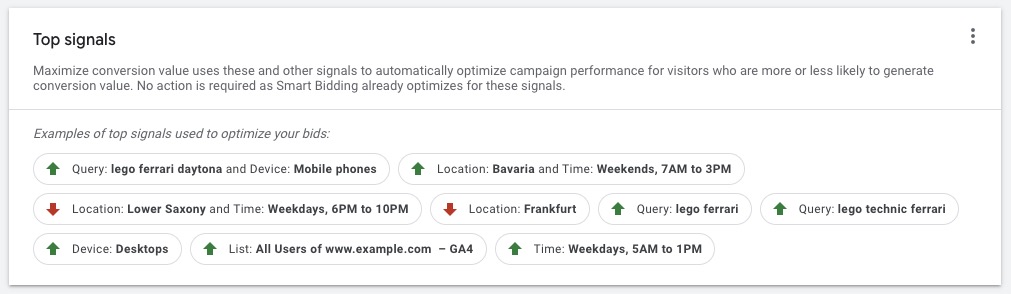
The learning phase is a testing phase
With the signals you provide as a starting point, PMax campaigns test the influences of various factors on performance. From my view, that’s one of the biggest advantages of the campaign type. Manually it’s simply impossible to test so many variables at the same time.
What happens specifically?
- Ad optimization: From the provided texts, images, and videos, Google creates a variety of ad combinations. In the learning phase, Google identifies the strongest combinations. You can see which in the Asset Details. More: PMax Asset Performance Analysis.
- Testing landing pages: With PMax default settings, other relevant pages of your website can be used as landing pages automatically.
- Testing audiences and keywords: Google determines which search queries and audience segments lead to conversions. These can deviate strongly from the self-defined signals.
- Testing remarketing: PMax campaigns also function as a dynamic remarketing campaign. Especially at the start, the campaign often focuses on „warm” remarketing audiences.
- Factor of location, time, and more: Region, day, time of day, device. All this data is analyzed.
- Training the bidding strategy: The algorithm learns how to use the budget so the conversion probability rises.
- Testing products: For campaigns with a Merchant Center feed, products are tested. Google often identifies the best performers and focuses on them.
How long does the learning phase for PMax campaigns last?
The typical duration is 2 to 4 weeks. It strongly depends on budget and conversion volume:
- High daily budget (300+ USD) and stable conversion volume: 1-2 weeks
- Standard setup (50-100 USD daily budget, 30+ conversions/month): 2-4 weeks
- Small budget (under 50 USD/day) or weak conversion data basis: 5-6 weeks
Google itself doesn’t give a hard guarantee. What you do know for sure: without at least 30-50 conversions per 30 days, Smart Bidding doesn’t find stable optimization. Concrete thresholds by bidding strategy:
- Target-CPA: at least 30 conversions in 30 days
- Target-ROAS: at least 50 conversions in 30 days
If you want a successful PMax campaign, there’s no way around this learning time. Still, it’s important not to draw premature conclusions when performance fluctuates in the first weeks.
A first solid assessment of the campaign can be made after 2-4 weeks, depending on data volume.
By the way: In another post I’ve collected all the important points to optimize Performance Max campaigns.
Which factors influence the duration of the learning phase?
As often, the answer should actually be: It depends.
If you have an existing account with available and well-maintained conversion and audience data, that shortens the learning phase. PMax campaigns also use the data from other campaigns and the entire account.
Which data is beneficial?
- Existing conversion data in the last 2-3 months
- Filled remarketing audiences and Customer Match lists
- Information on audience segments
- Performant keywords
Data volume is also relevant
Of course, data volume also influences the learning phase. If you want to advertise a wide variety of products and landing pages with a campaign, the algorithm takes longer to collect significant data.
Asset-group-specific learning phase
Important to understand: The learning phase applies not only at campaign level, but also per asset group. A new asset group in a running campaign has to go through its own learning phase, even when the overall campaign is already running stably.
That’s a common pitfall in campaign restructures: you rebuild the structure, think „the campaign knows that already”, and then wonder about fluctuating performance in the first weeks.
What triggers a new learning phase?
Each of these changes can reset or extend the learning phase:
- Budget change of more than 20 percent. That’s the most important threshold. Those who scale should work in 15-20 percent steps, not in big jumps.
- Change of Target-CPA or Target-ROAS.
- Change of bidding strategy (e.g., from Maximize Conversions to Maximize Conv Value).
- Major asset swaps (multiple assets exchanged at once).
- Pause longer than 24 hours. Partial restart risk is real here.
- Adding or removing entire asset groups.
Small changes (single new headlines, slight audience signal adjustments) usually don’t trigger a complete reset, but a short recalibration.
You want more results with Google Ads?
Get a free Google Ads Reality Check: a compact video (about 10 minutes) showing where budget is slipping away in your account and what to change.
Get your Google Ads Reality Check →
Avoid these 3 mistakes in the learning phase
Three common mistakes to avoid:
1. Interrupting the learning phase
The data you provide Google when creating the PMax campaign serves as the basis for the learning phase. If you significantly change this during the first 2-4 weeks, that interrupts the learning phase.
What counts (see reset triggers above):
- Adding new asset groups
- Reworking asset groups (texts, images)
- Changing audience signals
- Changing products via Listing Groups
- Changing budget over ±20 percent
- Changing bidding strategy
By the way: Interrupting the learning phase can also be the reason your PMax campaign isn’t using the full budget: Why Performance Max isn’t spending the budget.
2. Changing conversion tracking
Conversion tracking is elementarily important for the success of your campaigns. Conversion data defines your success.
It’s your tool to communicate to Google what you want to achieve with the campaign. All changes to tracking or changing the campaign goal can have major effects on the learning phase and overall performance.
3. Stopping the campaign too early
Performance during the first 2-4 weeks isn’t decisive for the campaign’s potential. If you lose patience and stop the campaign early, you can miss a big chance.
Learning phase: investment for maximum performance
Machine Learning in Google Ads is becoming more important. Not for nothing does Google constantly recommend switching running campaigns to Performance Max.
To run successful campaigns with Google Ads also in the future, it’s important to understand Google’s AI. Since every business is different, it needs time to learn which factors lead to success.
If you read this post until here (thanks), I want you to take these 3 points with you:
- Performance Max campaigns are actually multiple campaigns in one. The AI needs time to analyze all the data and maximize performance, 2-4 weeks depending on budget.
- In the learning phase, all provided and identified signals are analyzed and tested. Also per asset group.
- Set up your campaign properly from the start and don’t make big changes in the first 2-4 weeks, especially no budget steps over 20 percent.
I hope I could help you with this post and wish you success with your campaigns.
Work smart with Clicks in Mind
You might also like
 Performance Max
 Negative Keywords for PMax: How to Use Them Right
Add negative keywords directly to PMax, up to 10,000 per campaign. How to use the feature optimally for Search and Shopping ads.
Read more → Performance Max
 Analyze PMax Asset Performance: How to Do It in Google Ads
Here you learn where to find PMax asset evaluation, how to use Asset-Group-level Search Terms, and how to pull hard performance data with the Asset Auditor.
Read more → Performance Max
 Analyze PMax Campaigns: How to Do It (+ Hidden Reports)
Learn all the ways to evaluate your Performance Max campaigns, including Channel Performance Report, Asset-Group-level Search Terms, and demographic audience reporting.
Read more →You want more results with Google Ads?
Get a free Google Ads Reality Check: a compact video (about 10 minutes) showing where budget is slipping away in your account and what to change.
Get your Google Ads Reality Check